Confirmed facts, then the offer
Houston announced on October 12, 2026 that it acquired Marvin Harrison Jr. from Arizona. The announcement confirms the transaction, not his future target share or game availability. Read the primary source.
Source checked October 16, 2026. No projected target share, injury recovery date, trade acceptance odds or competitor score has been substituted for a verified fact.
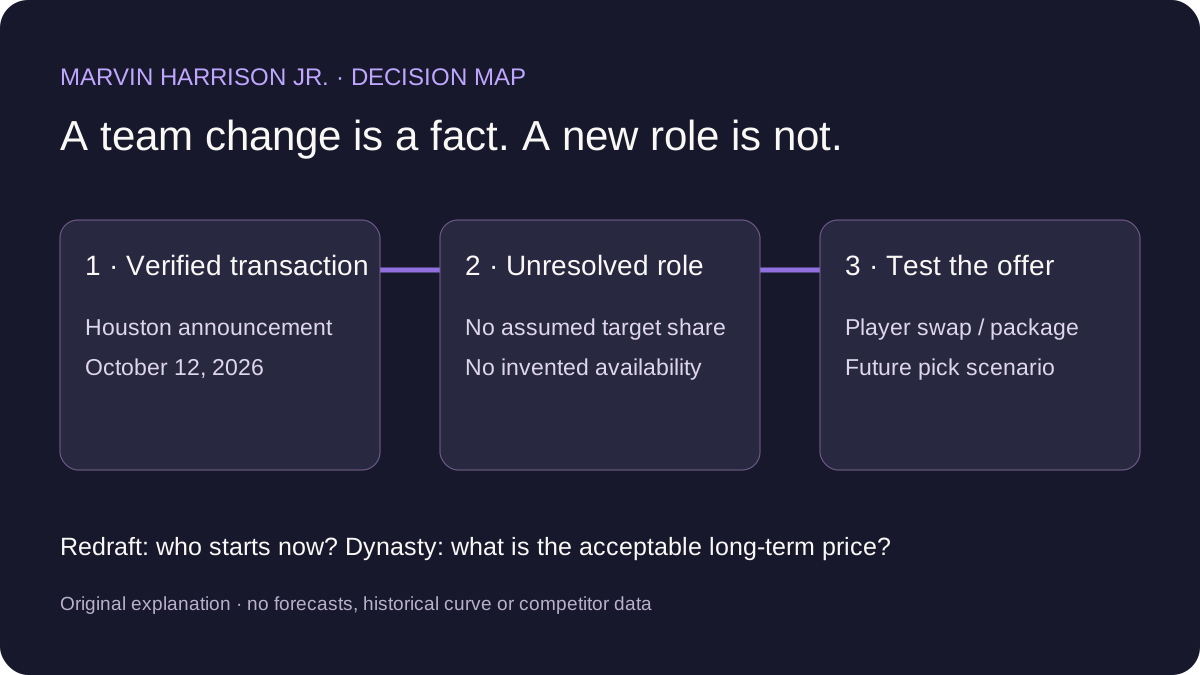
What changed after the Houston trade?
The confirmed team change is the starting point. It is not a projection of snaps, routes or touchdowns. Before increasing an offer, establish which receiver leaves your lineup and how long you can tolerate an uncertain role. The local team field now says HOU, but the underlying dated editorial index is still an estimate. The official announcement does not calibrate a new value for the calculator.
Redraft and dynasty need different price limits
In redraft, a roster that needs a usable starter immediately has less room for a transition than one with established depth. In dynasty, compare the longer horizon with what a future pick actually buys. Neither format makes an uncertain early first-round pick a guaranteed player. Run both league modes on the same offer, then write down the reason for any different decision instead of interpreting a changed index as a new fact about Houston.
When the buy case fails
Do not buy simply because a seller calls the move a fresh start. A lower-than-assumed role, a starter you cannot replace, or a package that forces a useful cut can defeat the thesis. Conversely, do not sell only to eliminate an uncomfortable unknown. If the offered depth stays on your bench, the additional names may not compensate for the receiver you surrender. The examples below are research starting points, not suggested completed deals or acceptance probabilities.
Three different offers to test
All examples use dynasty, 12 teams, 1QB and the same engine as the analyzer. They are not reported trades or calibrated market prices. Change the league before evaluating your own offer.
Receiver swap
Receive Marvin Harrison Jr.; send DeVonta Smith.
Package index 87 vs 76. Active-player difference 0. Cuts and points are separate checks.
Compare a same-position pivot before adding picks.
Run this exact offer →Depth for one receiver
Receive Marvin Harrison Jr.; send Jaylen Warren + Terry McLaurin.
Package index 87 vs 116. Active-player difference -1. Cuts and points are separate checks.
Check whether both outgoing players would start and who fills the open slot.
Run this exact offer →Future capital
Receive Marvin Harrison Jr.; send 2027 Mid 1st.
Package index 87 vs 66. Active-player difference 1. Cuts and points are separate checks.
A dynasty-only hypothetical; the pick is not an active roster player.
Run this exact offer →Watch the actual tool workflow
No audio. Real local-tool recording with dated model values and illustrative inputs. Open an offer, run analysis, inspect the index and independent scoring layer, then change one assumption and run it again.
Before you accept
Compare one actual offer, identify who starts afterward, and check current team news again. A model-close offer does not prove that either manager should accept. A stale or missing fact is a reason to investigate, not to invent a price adjustment.
fantasy football trade value chart · dynasty trade analyzer · 2 for 1 fantasy football trade calculator ·
Marvin Harrison Jr. trade questions
Is the displayed value a real market price?
No. The index is our dated editorial baseline with disclosed format adjustments. None of the three offers is a reported transaction or guaranteed acceptance.
Which offer should I try first?
Compare a same-position pivot before adding picks. Then compare the other scenarios if they answer your actual roster problem. Do not exchange players just to match an index.
What would make holding sensible?
The Houston move changes what to investigate, not an automatic price multiplier. Buy only at a price you can justify without assuming an immediate lead-receiver role. Hold if an offer pays only for uncertainty; consider selling if it already requires your most optimistic role scenario.