Confirmed facts, then the offer
Seattle's official 2026 player table showed 37 receptions, 583 receiving yards and seven receiving touchdowns through five games when reviewed October 16. That observed window is not a forecast of the next five games. Read the primary source.
Source checked October 16, 2026. No projected target share, injury recovery date, trade acceptance odds or competitor score has been substituted for a verified fact.
Current evidence and valuation limits
The official receiving totals establish the production window being discussed. They do not establish today's clearance, a guaranteed weekly floor, or a league-wide sale price. Our asset index comes from our own dated model; it is not copied from a competitor's market score. Compare that baseline with an actual offer you can receive. A price nobody in your league is willing to pay is not an actionable alternative.
Same-position swap or a different roster job?
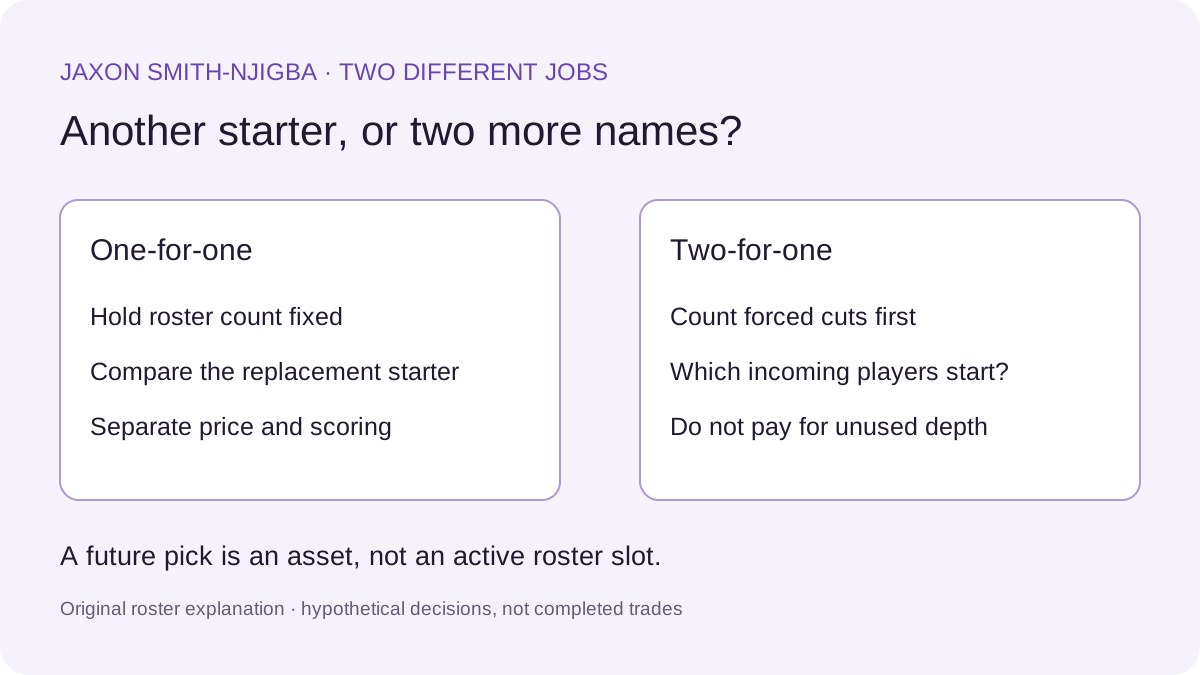
A swap for another receiver keeps the number of roster spots unchanged and makes risk, time horizon and scoring assumptions easier to isolate. A cross-position offer is a different question: an excellent running back may fill a vacancy, but identify the receiver you would now start. The calculator can compare assets and a separate reception scenario. It cannot know that your bench replacement is available or project a weekly lineup from the index alone.
Do two incoming names improve your starting lineup?
Count active players, not total assets. Receiving two players for one can force a cut when there are no open slots; receiving a player plus a future pick does not have the same cost. Enter the likely cut and replacement assumptions in the result's roster check. If only one incoming player starts, ask whether the second piece truly closes the gap. Keeping the better single starter is a reasonable outcome, even when a raw sum favors the larger package. No local historical price curve is asserted on this page.
Three different offers to test
All examples use dynasty, 12 teams, 1QB and the same engine as the analyzer. They are not reported trades or calibrated market prices. Change the league before evaluating your own offer.
Same-position comparison
Receive Jaxon Smith-Njigba; send Puka Nacua.
Package index 96 vs 98. Active-player difference 0. Cuts and points are separate checks.
Hold the position and roster count fixed.
Run this exact offer →Position pivot
Receive Jaxon Smith-Njigba; send Breece Hall.
Package index 96 vs 79. Active-player difference 0. Cuts and points are separate checks.
Test a receiver need without pretending the index predicts lineup points.
Run this exact offer →Two players for one
Receive Jaylen Warren + DeVonta Smith; send Jaxon Smith-Njigba.
Package index 125 vs 96. Active-player difference 1. Cuts and points are separate checks.
The receiving side must review forced cuts and real starting roles.
Run this exact offer →Watch the actual tool workflow
No audio. Real local-tool recording with dated model values and illustrative inputs. Open an offer, run analysis, inspect the index and independent scoring layer, then change one assumption and run it again.
Before you accept
Compare one actual offer, identify who starts afterward, and check current team news again. A model-close offer does not prove that either manager should accept. A stale or missing fact is a reason to investigate, not to invent a price adjustment.
puka nacua trade value · fantasy football trade value chart · 2 for 1 fantasy football trade calculator ·
Jaxon Smith-Njigba trade questions
Is the displayed value a real market price?
No. The index is our dated editorial baseline with disclosed format adjustments. None of the three offers is a reported transaction or guaranteed acceptance.
Which offer should I try first?
Hold the position and roster count fixed. Then compare the other scenarios if they answer your actual roster problem. Do not exchange players just to match an index.
What would make holding sensible?
A receiver swap and a depth-for-star package solve different problems. Keep Smith-Njigba when incoming depth would sit on your bench. Consider a package only when its usable starters solve a real vacancy after cuts and replacement costs.